May 23rd, 2013

Memorial Day didn't become an official holiday until 1971, but Americans started gathering annually in the spring to remember those who lost their lives in war during the 1860s, right after the Civil War. Celebrated on the last Monday in May, people still decorate the grave sites of war veterans and hold memorial services, but Memorial Day has also evolved into a day that signifies the beginning of summer.
During the summer months, many people take road trips to visit family members. Some head off to the airport to enjoy a long-awaited vacation far away, while others look forward to spending time with friends and family at home. However you spend Memorial Day and the subsequent summer months, there are a few things you can take care of to ensure your summertime is enjoyable.
Checklist for an Enjoyable Summer
- Have the AC Checked. During the hottest days of summer, many families find themselves sweating it out due to a broken air conditioning system. Be proactive so you can avoid waiting for hours or days because the HVAC repair person is booked solid. Have your air conditioning system checked before or around Memorial Day each year.
- Ensure Security While You're Away. When you leave for vacation, the last thing you should have to worry about is the security of your home. Install a home security system, if possible, and put a timer on your lights so they go on and off at normal hours. You can also alert your local police department that you'll be gone, and ask them to drive by your house once in a while to make sure everything is okay.
- Visit Dr. Frech Before Vacation. Many people put off school-related or annual health exams until after summer vacation. Avoid the crowds and make sure your physical and oral health are in top shape prior to vacation time so there are no unpleasant surprises.
- Plan Your Memorial Day Traditions. Whether you host a barbecue in the Wichita Falls, TX area or beyond, gather for the parade, or spend time at a loved one's grave site, plan your Memorial Day happenings in advance so those you wish to include can be there.
Our team at Wichita Falls Orthodontics wants you to look forward to Memorial Day and the days of summer by preparing to spend the time safely and comfortably. As you plan ahead, take care of your health and secure your home, you can place your focus on creating memories with family members and friends while enjoying your favorite Memorial Day traditions.
May 16th, 2013

While braces play an important part in helping to create a healthy mouth and teeth, you might experience a few side effects while wearing them that are common and can be easily treated.
Even with the best of care, braces can cause soreness to your mouth. As your teeth begin to move, it is natural for your teeth to feel aches and your jaw to develop soreness.
If there are broken wires or loose bands on your braces, a sore tongue, mouth, or canker sore will occur. Canker sores are a common occurrence when braces rub inside the mouth. There are ointments available to reduce the pain and irritation associated with mouth sores. We urge those who experience a sore mouth or any of the following problems to call our office to schedule an appointment.
- Loose brackets: Apply a small amount of orthodontic wax to the bracket temporarily. You might also apply a little between the braces and the soft tissue of your mouth.
- Loose bands: These must be secured in place by your orthodontist. Try to save the band for repair.
- Protruding or broken wires: The eraser end of a pencil can be used to move the wire carefully to a less painful spot. If you are unable to move it, apply orthodontic wax to the tip. If a mouth sore develops, rinse with warm salt water or antiseptic rinse.
- Loose spacers: These will need to be repositioned and sometimes replaced.
Foods to Avoid
Some foods can also help or hurt you while you’re wearing braces. Remember to cut your food into small pieces that can be easily chewed. You will want to avoid hard and chewy foods that can break your hardware. Foods such as corn on the cob, nuts, carrots, apples, ice, and bubble gum should be avoided.
Braces, rubber bands, springs, and other mouth appliances associated with braces will normally attract food particles and plaque. Without the proper care, this could cause staining of your teeth.
Our staff at Wichita Falls Orthodontics recommend brushing after every meal or snack and carefully removing any food that might be lodged in the braces. A fluoride mouthwash might be helpful as well as flossing. At your next appointment, Dr. Frech can advise you how to floss with a brush specially designed for braces!
May 9th, 2013
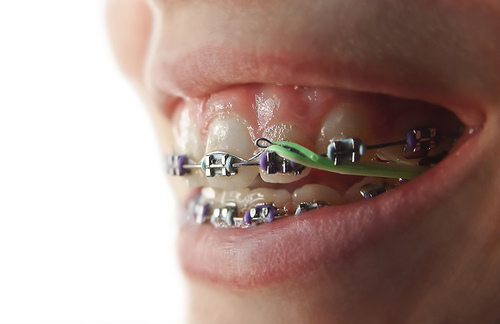
Most of our patients at Wichita Falls Orthodontics will need to wear rubber bands at some point during their orthodontic treatment. The main reason our patients are instructed to wear rubber bands is to correct their bite. If your teeth do not fit together properly, Dr. Frech will recommend that rubber bands be used. Dr. Frech may also recommend using rubber bands to close or open spaces.
Rubber bands are a critical part of your treatment, and wearing them as Dr. Frech and our team recommend will help move your teeth into the desired position. Dr. Frech may ask you to wear your rubber bands full time, meaning that they should only be taken out when you brush and floss your teeth three times a day. Other times, you may be asked to only wear them part-time, like only during the day or only during sleep.
If you still have any questions about orthodontic rubber bands, we invite you to give us a call or ask us during your next adjustment appointment. Remember, wearing rubber bands as prescribed by Dr. Frech is an important step during your treatment, and can reduce the time you have your braces. If you lose your rubber bands or run out, stop by our Wichita Falls, TX office and pick up more!
May 2nd, 2013

At Wichita Falls Orthodontics, we know image is everything, especially for today’s teenagers. At an age when image is so important, the thought of having braces may intensify the already-delicate confidence of today’s teens. Well, May is National Teen Self-Esteem Month, and during this time, parents are encouraged to act as positive role models, help stop negative self-images, and improve confidence and security among teenagers.
Dr. Frech and our team will tell you one of the great ways to improve your confidence is to improve your smile. And that begins with a consultation at Wichita Falls Orthodontics. After all, what better time to avoid having crooked teeth in your adulthood than coming in for a consultation with Dr. Frech?
We are happy to treat today’s image-conscious teens, and invite you to give us a call to schedule an initial consultation at our convenient Wichita Falls, TX office!